Visuray Commercially Launches VR360 X-Ray Well Integrity Services.
Direct measurements for single- and dual-casing well integrity evaluation, enabling real-time data-driven decision-making for planning and productivity assurance.
Example Application, Multiple Casing
Gamma Ray
Casing
Collar Locator
Shallow ⌀8″
Medium ⌀10″
Deep ⌀13″
Density x̄
Azimuthal
Variability
Depth (m)
Bore
⌀5-6½″
Shallow
Annulus A
⌀7-8½″
Medium
Annulus B
⌀9⅝-12″
Deep
Formation
⌀12-13½″
Ultra Deep
Formation
⌀>13½″
Well Schematics





Applications.
- Single- and multi-casing well integrity evaluation.
- Single- and multi-casing zonal isolation/cement evaluation.
- Sidetrack well candidate selection.
- Gravel pack integrity monitoring.
- Shale barrier evaluation.
- Casing thickness evaluation.
Benefits.
- Direct measurement is independent of wellbore properties. X-rays penetrate and return through fluid, steel, cement, and rock.
- Provides real-time results with direct illumination from the wellbore outwards, radially, and circumferentially.
- Measurement is not impaired by debonding, cement types, fluid types, casing types, or gas.
- Identifies radial density features at multiple depths of investigation and 360° around the wellbore.
- Produces density distribution maps of material behind multi-casing, unaffected by micro-annulus, at various depths of investigation, in real-time, indicating channels in the cement, their depth, and location.
VR360 X-Ray Well Integrity Evaluation.
How it Works & Technical Specifications
The increasing emphasis on verifying rock-to-rock barriers without extensive casing removal has created a need for diagnostic technologies capable of imaging the annular environment through multiple casing strings. X-ray–based density measurements offer a fundamentally different approach because they respond directly to density variations within the surrounding well structure rather than relying on acoustic coupling across interfaces. Density contrasts associated with mud channels, voids, fluid-filled regions, and degraded cement can therefore be detected even in environments where acoustic methods may be ineffective.
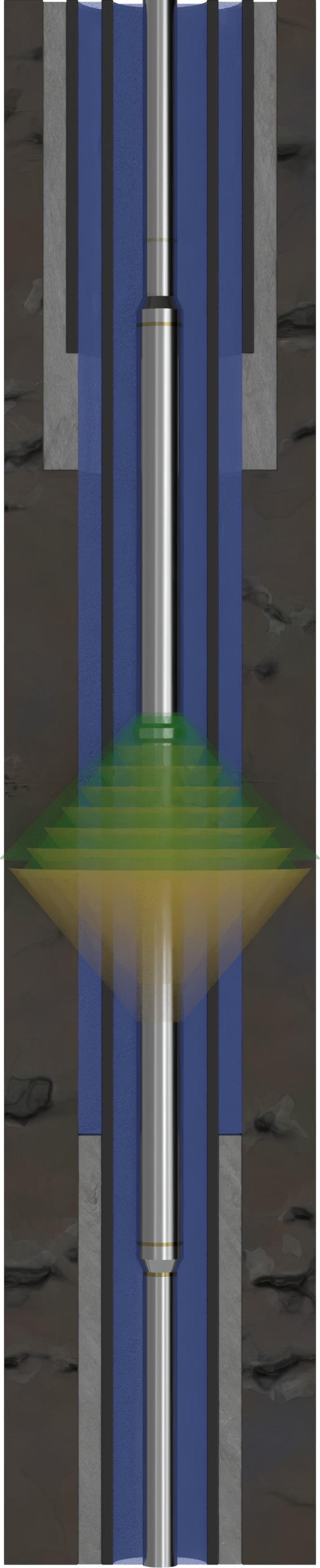
The VR360 operates like an inside-out CAT scan. As the tool is conveyed through the well, a 360-degree X-ray beam penetrates the borehole and surrounding annuli through fluid, steel, cement, and rock. The emitted photons interact with the formation and well materials, scatter back toward the tool, and are captured by a cylindrical detector array.
The logged data is converted into three-dimensional radial profiles at multiple depths of investigation and transmitted to the surface via conventional wireline for real-time processing. The resulting density distribution maps and continuous depth logs highlight features by annulus, enabling operators to make real-time, data-driven decisions for planning and productivity assurance.
| Specifications* | Imperial | Si |
|---|---|---|
| Pressure Rating | 10,000 psi | 700 bar |
| Temperature Rating | 257 °F | 125 °C |
| Tool Outer Diameter (w/options) | 4 ¾ in (5 ½ in) | 121 mm (140 mm) |
| Length | 44 ¼ ft | 13.5 m |
| Weight | 940 lbs | 426 kg |
| Depth-of-Investigation, w/dual casing | ≥ 8 in | ≥ 200 mm |
| Field-of-View, Azimuthal | 360 ° | |
| Logging Speed (Recommended) | 200 to 1,800 ft/hr | 1 to 9 m/min |
| Power Consumption (Max.) | 1,000 Watt | |
| Wireline Voltage (Max required) | 1,000 Volt | |
| Cablehead Type | 1 ³⁄₁₆ in GO A PIN | |
| Monocable Spec | NS Z-015 Annex F4 (<200 Ω) | |
| *All specifications are provided for reference purposes only and may be modified without notice. Final product configuration is subject to project-specific requirements, site conditions, and agreed scope of work. | ||

